
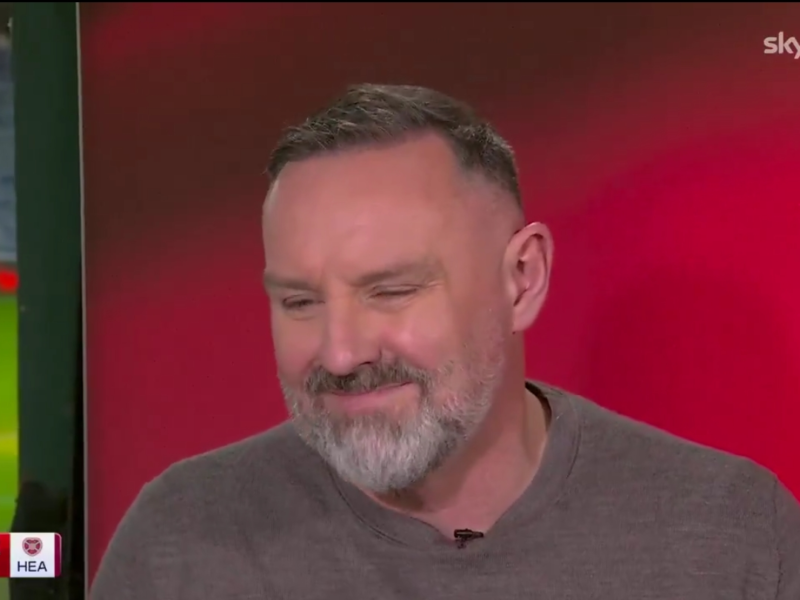
Kris Boyd’s most recent appearance on Sky Sports during Celtic’s victory over Kilmarnock felt less like measured breakdown and more like a bar-room tirade, the sort that sounds bold until you pause and properly examine it.
Listening to Boyd analyse the stoppage time at Rugby Park, it was difficult to shake the sense that he was chasing a viral soundbite rather than delivering anything close to balanced punditry.
Following complaints from Neil McCann, Boyd zeroed in on the added minutes, steering the conversation toward suggestion and suspicion instead of applying straightforward match reasoning.
His main claim was that three half-time substitutions could not be factored into second-half stoppage time. On that specific detail, he is technically right. But that was never the basis for the seven minutes displayed, and that is where the entire case falls apart.
There were four separate substitution windows in the second period alone. Kilmarnock also endured multiple pauses for medical attention, including Lyons after taking the ball flush in the face and John Jules, who needed treatment before limping off with a muscle issue.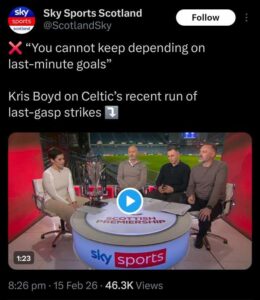
Factor in two goals, drawn-out restarts and the predictable game management from the hosts as the contest progressed, and seven minutes appears perfectly justifiable. If anything, it could easily have stretched to eight or nine.
None of that seemed relevant to Boyd.
Speaking on Sky Sports, he said: “There was three substitutions at half time, so they can’t be added onto the second half. I’m sure the board, they could actually just change it to say ‘until Celtic score’ just hold the board up and say that.”
Kris Boyd’s most recent appearance on Sky Sports during Celtic’s victory over Kilmarnock felt less like measured breakdown and more like a bar-room tirade, the sort that sounds bold until you pause and properly examine it.
Listening to Boyd analyse the stoppage time at Rugby Park, it was difficult to shake the sense that he was chasing a viral soundbite rather than delivering anything close to balanced punditry.
Following complaints from Neil McCann, Boyd zeroed in on the added minutes, steering the conversation toward suggestion and suspicion instead of applying straightforward match reasoning.
His main claim was that three half-time substitutions could not be factored into second-half stoppage time. On that specific detail, he is technically right. But that was never the basis for the seven minutes displayed, and that is where the entire case falls apart.
There were four separate substitution windows in the second period alone. Kilmarnock also endured multiple pauses for medical attention, including Lyons after taking the ball flush in the face and John Jules, who needed treatment before limping off with a muscle issue.
Factor in two goals, drawn-out restarts and the predictable game management from the hosts as the contest progressed, and seven minutes appears perfectly justifiable. If anything, it could easily have stretched to eight or nine.
None of that seemed relevant to Boyd.
Speaking on Sky Sports, he said: “There was three substitutions at half time, so they can’t be added onto the second half. I’m sure the board, they could actually just change it to say ‘until Celtic score’ just hold the board up and say that.”
It is the type of remark crafted to inflame rather than inform. The suggestion that officials were effectively waiting for Celtic to find a winner disregards how stoppage time is actually determined and underestimates anyone who watched the match objectively.
Boyd’s on-screen persona increasingly resembles that well-known figure in every local pub: loudly certain, perpetually irritated and convinced there is always an agenda at play. The difference is that, when broadcast nationally, that tone shifts from harmless exaggeration to something that shapes misguided narratives.
Celtic netted late because they continued to apply pressure, not because a fourth official was raising an imaginary “until Celtic score” board. The added minutes did not hand them the result. The rhythm of the game, the interruptions and the moments on the pitch did.
And Kilmarnock were afforded the same seven minutes. They, too, had the opportunity to find a goal.
Boyd is free to criticise Celtic. He is free to challenge decisions. But when commentary strays this far from basic logic, it ceases to be sharp analysis and starts to resemble satire.