Hampden Park witnessed one of the most emotionally charged moments of the Scottish football season on May 23, 2026, as Neil Lennon—once a deeply polarizing figure at Celtic—found himself unexpectedly serenaded by the same fans who once turned against him.
Despite his Dunfermline Athletic side falling 3-1 to Celtic in the Scottish Cup final, the atmosphere inside the stadium shifted in a way few could have predicted. As the match slipped away from the Championship underdogs, something remarkable happened: Celtic supporters began chanting Lennon’s name.
A Surreal Moment at Hampden Park
With Celtic firmly in control of the final, leading 3-1 late in the second half, the travelling support made a spontaneous gesture that stunned viewers, pundits, and even Lennon himself.
The former Celtic manager—once at the heart of intense division during his second spell at Parkhead—was suddenly being applauded and sung to by sections of the same fanbase that had previously protested his leadership.
Lennon, known for his fiery personality and emotional honesty, could not hide his reaction.
“They weren’t singing it five years ago,” Lennon said with a smile in his post-match interview. “But they sang it today. So yeah, that was a nice touch.”
It was a brief but powerful moment that captured the unpredictable emotional swings of football and the complicated legacy Lennon carries within Celtic history.
The Match: Celtic’s Quality Prevails
On the pitch, Celtic’s superiority eventually told the story. Managed by Martin O’Neill in a symbolic twist of football fate, Celtic demonstrated clinical efficiency in front of goal.
Dunfermline Athletic, led by Lennon, entered the final as massive underdogs but initially showed resilience and structure. Their journey to Hampden had already been impressive, including a dramatic penalty shootout victory over Falkirk in the semi-final.
Lennon had even warned before the match that underdogs in finals can “bite”—and for a brief spell, his side looked capable of making life difficult for the champions.
However, quality ultimately prevailed.
- 19th minute: Daizen Maeda opened the scoring for Celtic
- Before half-time: Arne Engels doubled the lead with a composed finish
- 73rd minute: Kelechi Iheanacho made it 3-0, effectively sealing the game
- 80th minute: Josh Cooper pulled one back for Dunfermline
The final scoreline of 3-1 secured Celtic yet another domestic triumph and underlined the gap in experience and squad depth between the two sides.
Lennon’s Honest Post-Match Reflection
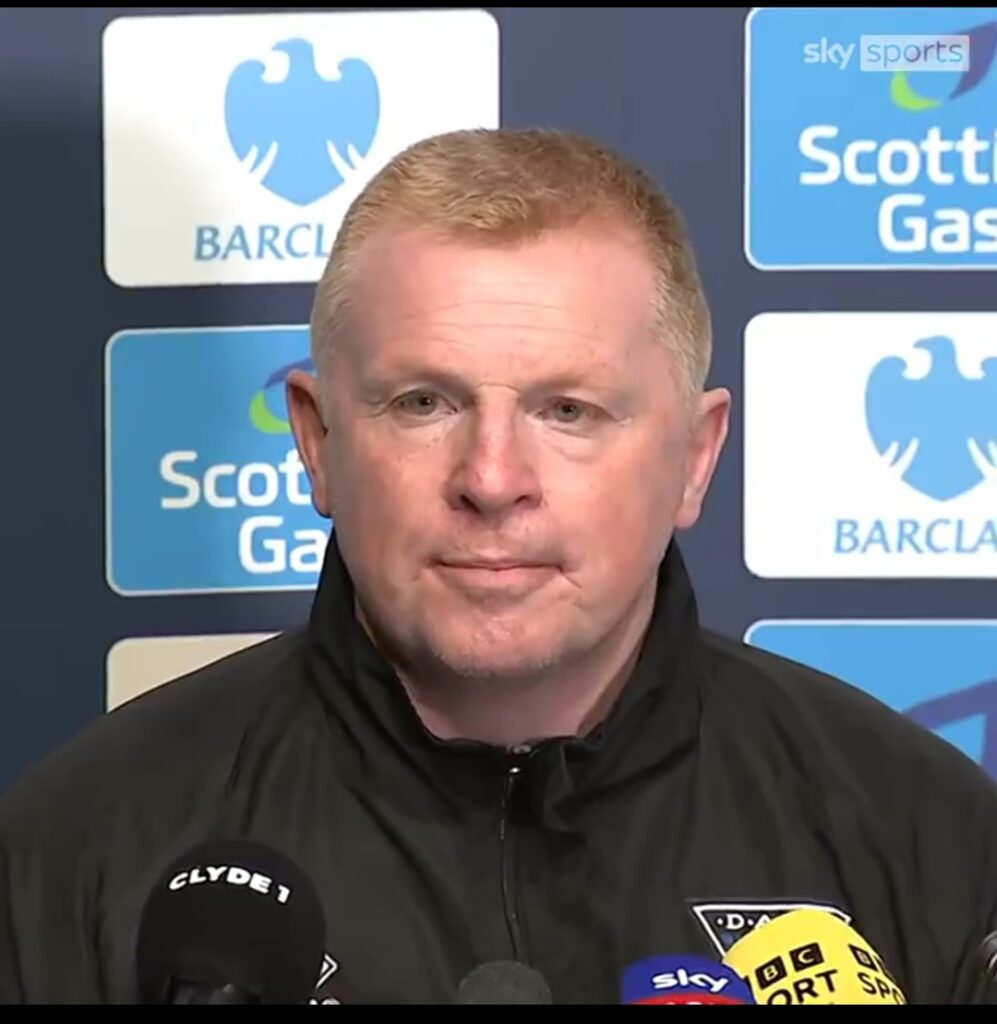
True to form, Neil Lennon did not sugarcoat his assessment after the final whistle. Speaking to Sky Sports, he admitted his team struggled to maintain composure once Celtic gained control of the game.
“I thought we started okay and then once Celtic scored, we got a little bit discombobulated,” Lennon explained. “We weren’t brave enough on the ball and mentally we sank a little bit.”
Despite the disappointment, he remained proud of the players’ effort and second-half response.
“The better team won, there’s no question about that,” he added. “But there were moments where we needed to be more clinical, and that’s where Celtic showed their level.”
The contrast in execution was clear. Celtic punished mistakes instantly, while Dunfermline struggled to convert their limited opportunities.
A Season That Exceeded Expectations
While the final ended in defeat, Dunfermline’s overall campaign under Lennon has been widely viewed as a success.
Appointed initially on a short-term deal in March 2025 to help the club avoid relegation, Lennon quickly transformed the team’s identity. His impact was immediate, instilling discipline, structure, and belief.
That transformation eventually led to a new two-year contract and a remarkable run that included:
- A Scottish Cup final appearance
- A competitive push in promotion play-offs
- Improved defensive organization and resilience
For a club operating with limited resources, reaching Hampden alone marked a significant achievement.
“I’ve got to pay tribute to the supporters today. A hell of a turnout. It was magnificent,” Lennon said, acknowledging the travelling Dunfermline fans.
Summer Rebuild Already Looming
Despite the progress, Lennon was brutally honest about what comes next. The squad that reached the final is unlikely to remain intact.
“A lot of these players won’t be here next year,” he admitted. “We’ve offered them contracts… I’m assuming they’re going to go elsewhere.”
This looming rebuild presents both a challenge and an opportunity. With several key players out of contract, Dunfermline face a critical summer window that will define whether this season was a breakthrough or an isolated peak.
Lennon’s experience managing at the highest level will be crucial in recruitment and squad restructuring. His track record at clubs like Celtic and Hibernian demonstrates his ability to rebuild squads under pressure.
The Complex Celtic–Lennon Relationship
Few figures in modern Scottish football have a relationship with Celtic as layered as Neil Lennon.
As a player, he was a key figure during the Martin O’Neill era, winning multiple league titles and cups. As a manager, he delivered silverware and stability during transitional periods.
However, his second managerial spell between 2019 and 2021 significantly changed his standing among supporters. The collapse of Celtic’s “ten-in-a-row” ambition, combined with poor results and intense scrutiny, led to growing fan unrest.
Protests, criticism, and pressure eventually forced his departure, leaving a complicated legacy behind him.
Yet football has a way of reshaping narratives over time.
Five years later, the Hampden chants suggest a softening perspective. With emotional distance and nostalgia, fans often reassess figures from the past—especially when those figures are no longer direct sources of frustration.
Respect Between Managers: Lennon and O’Neill
The final also carried emotional weight due to the presence of Martin O’Neill in the Celtic dugout.
O’Neill, who previously managed Lennon during his playing days, faced his former captain in a competitive final setting—adding a layer of symbolism to the occasion.
Lennon was full of admiration when discussing O’Neill’s continued influence in football.
“I think he’s put himself in the best position,” Lennon said. “I don’t see many other candidates out there that could do what he’s done this season.”
Post-match, the handshake and brief exchange between the two managers reflected mutual respect and shared history.
What Comes Next for Neil Lennon?
At 54, Lennon remains deeply committed to management and shows no sign of stepping away from the game. His post-match comments reflected both realism and determination.
“Everybody’s career has highs and lows,” he said. “The great managers have had incredible highs and lows. So you keep coming back for more.”
That resilience has defined his career—from player to manager, from success to controversy, and now to rebuilding at Dunfermline.
The challenge ahead is significant. Competing in the Scottish top flight—or pushing for it—will require strategic recruitment, tactical flexibility, and consistency.
A Full-Circle Football Moment
The image of Celtic fans chanting Neil Lennon’s name while he stood on the losing side of a cup final will remain one of the defining scenes of the season.
It encapsulated everything unpredictable about football: loyalty, memory, emotion, and redemption—all colliding in a single moment.
For Lennon, the defeat hurts, but the unexpected recognition may carry its own meaning. It suggests that legacy in football is never fixed—it evolves with time, context, and perspective.
Whether this moment represents a true rehabilitation of his image among Celtic supporters or simply a spontaneous gesture from a nostalgic crowd, it adds another fascinating chapter to his long and eventful career.
Conclusion
Neil Lennon walked away from Hampden Park without a trophy, but not without impact. His Dunfermline side pushed beyond expectations, his honesty once again stood out, and his name echoed from the stands of a club where his legacy remains deeply complex.
In football, narratives rarely stay still. Heroes become critics, critics become respected figures, and sometimes—if only for a moment—the crowd remembers the past with affection rather than judgment.
For Neil Lennon, that moment came at Hampden Park on a day of defeat, but also unexpected recognition. And in football, those contradictions are often what make the story unforgettable.
